
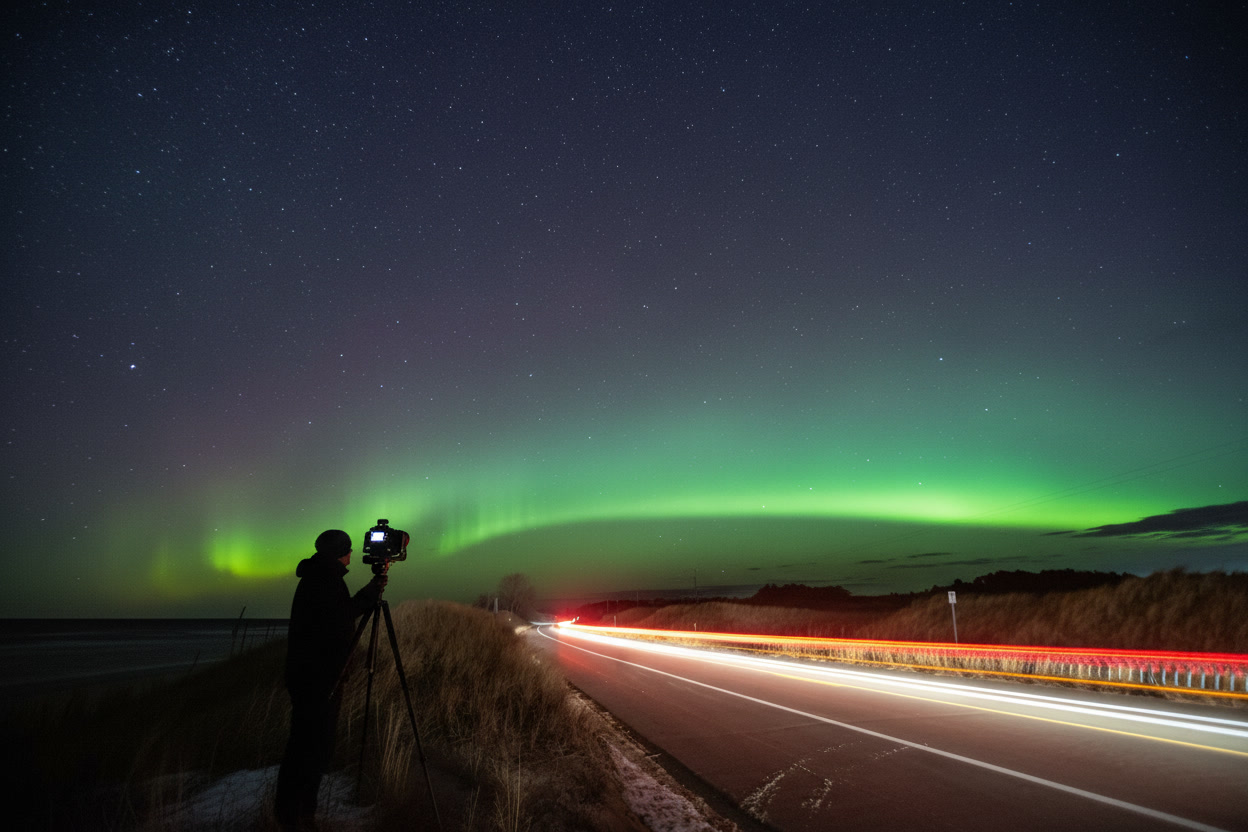

One thing that infrequently discussed in our photography community is safety. For National Parks, State Parks and Private locations to welcome us and to expand services. The community as a whole needs to have good and safe reputation.
This can be helped if we start to adopt uniform guidelines to how we behave in the dark. Little things in how and when we do things, will improve the experience for everyone and avoid conflicts. It also will improve safety.
Typically it is not the experienced hunters that make critical mistakes. It is the people who have never been hunting, that don’t know what to do and up making a mistake. We have actually had people killed by a car in lower Michigan, when two people stopped to see lights after they had been drinking. Parked on the opposite side of the road than where they were going, and stepped in front of a car that didn’t see them. Even though they weren’t a hunter, it does reflect on the community. It makes parks and public places question whether it is safe to stay open at night.
I am going to post some guidelines here. I propose that we all make an effort before every large aurora event to share this news agencies, community forums and on our social media. Lets build awareness of how we should behave in the dark. Especially for people who have never seen Northern Lights. This ensures we all know what to do in the dark and it will lead to everyone being safe and having a good time.
Guidelines for Aurora Hunting
1. Your eyes will take several minutes to adjust to the darkness, so turn off your car lights as soon as you park. Wait a few minutes before venturing away from your car to give your eyes time to adjust. Use this time to run your checklist to make sure you have everything need with you, set your camera settings and make sure your car is secured.
2. Set your focus before walking out to the location. This way, you can use a flashlight without disturbing others who may be shooting. Double-check focus by Taking a photo, enlarging an image on the back of your camera to ensure the stars are tack sharp. You can take a small piece of masking tap, place it on side of your lens to avoid loosing your focus.
3. Set your white balance, shutter speed, f-stop, and ISO before leaving your car. This way, you can make minor adjustments in the field without struggling. A shutter speed of 20 to 30 seconds, the lowest f-stop possible (f1.4, f2.8, or f3.5), and an ISO of 1600 are good starting points. If you need more light, raise your ISO. If you find your stars are comma shaped, reduce your shutter speed.
4. Use a red light when walking to avoid disturbing your night vision. However, use a small pen flashlight (can be found at dollar stores) around other people—normal flashlight light is more white balanced and can be corrected in editing, However, red light is nearly impossible to fix. Being considerate of other photographers, earns you a warm welcome.
5. Keep all flashlights and headlamps pointed at the ground while walking. Avoid shining a flashlight at someone or at their face because you disturb their photography and blind them. Aim your light away from anyone you pass to avoid disturbing their night vision or photography. Make sure you greet them as you pass, so they are fully aware you are their.
6. Please note direction of camera lenses or note what they are shooting, then walk behind them so you don’t disturb their photos.
7. Be aware of your surroundings. If you note other photographers, ask if they mind if you set up near them. Most Aurora Hunters are really friendly. Many will welcome other photographers or newbies. However, some photographers might be uneasy with people they don’t know near them. Please Be Respectful. Take care not to put your camera in their shot as it will ruin their shot. Occasionally, photographers might welcome people in their shot at a distance because it adds interest.
8. If you find you need to use your flashlight and you are near other people. Call out a warning “I need to turn on my flashlight”, count to 30 before turning on your light. This avoids you ruining other peoples images with your unwanted light.
9. When using a Camera, we recommend learning the buttons and functions on the camera. This way you can find them by touch. This limits flashlight usage that could bother other people. Once you hit the buttons your LCD screen should allow you to adjust settings without need of external flashlight.
10. If you have come with a group of people. Don’t leave your wingman. Everyone should leave at the same time. This way if a car doesn’t start or someone is stuck help is available.
11. This is the most important rule of thumb. Always park on the side of Road you are going to. Never cross the road in the dark if you can help it.
12 Never park on both side of the road when at a busy location. This creates a bottle neck in traffic. If someone were to step out in on coming traffic , an oncoming car could not have a direction to move to avoid them, when cars are on both side of the road.
13. Follow the rules of the National Park, State Park or Local Park rules for where you are at. Park in designated parking spaces. We do have lot of handicapped people who enjoy seeing the lights. Please don’t make it unsafe for them by taking a handicap parking space if you don’t need it. Obey, signs that tell you areas are closed, they are rules not suggestions. Pick up trash you find, even if it is not yours. Carry a small bucket in your car all the time, this way should you find an unattended campfire you can put it out. Most of all, These parks are our homes, take the responsibility to care for them. We become welcomed by parks when we keep the park safer in the dark. It increases the chances more places will become open to us and less places will get closed due to issues.
14. Wear light color clothing, safety vests, clip on reflectors or flashlights if you are going to be by a road. This makes you visible to oncoming traffic and will save you from being hit. Really good tip, is to look at places like Menard’s for safety best with pockets, then you have convent place to put extra lens, keys, flashlights and cell phones while remaining visible. These vests can be worn in summer or slip over a coat in the winter.
15. Obey speed limits. When we have really large Aurora Events, and it is highly televised. We get a lot of people crowding into limited spaces. You might find people parked on road sides in strange places. Some photographers maybe setting up a shot using the road in the composition of their photo. It is best to slow down and assume that there could be people out there, that don’t think about safety around the road. You don’t want to be that person that hits them. It ruins everyone’s life and leaves you with a horrible memory that will haunt you.
Thank you for reading this, Share it often and Lets bring everyone home safely!
Leave a Reply